AuSpire collaboration drives international research to advance the energy transition
RMIT University and Moeve have celebrated their AuSpire collaboration at a milestone event in Madrid. Through the program, the organisations are co-supervising two postdoctoral fellowships and exploring new opportunities to connect research, talent and industry in support of the energy transition.
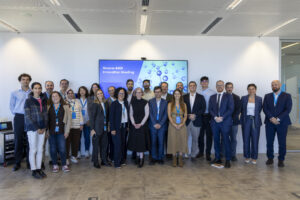
Attended by senior representatives from RMIT, Moeve and the Australian Government at the Moeve headquarters, the event showcased the impact of AuSpire in strengthening research connections between Australia and Spain.
The milestone celebrated the successful implementation of two AuSpire Fellowships at Moeve’s Innovation Centre, demonstrating how AuSpire creates opportunities for researchers to work across international institutions and industry and address pressing challenges in the transition to a low-carbon future.
The event also provided an opportunity to explore ways to expand the collaboration through talent development, industry–university engagement and stronger connections between Australian and Spanish research communities.
Connecting research, talent and industry across borders
The event featured two panel discussions showcasing how AuSpire connects international research talent with industry expertise to contribute to the concept of Planetary Wellbeing.
Panel 1: From Science to Real-World Impact: Meet the AuSpire Researchers
The first panel, From Science to Real-World Impact: Meet the AuSpire Researchers, brought together AuSpire researchers Dr Prakhar Mishra and Dr Dmitrii Vasenin, and Carlos Girón, Economic Director at Moeve and Asier Panadero, Innovation Lead in Energy Transition at Moeve. Dr Carlos Alberto Prieto from Moeve moderated the discussion that explored the objectives, innovative approaches and anticipated impact of the researchers’ projects.
Prakhar Mishra is investigating advanced materials for next-generation electrolysis technologies for green hydrogen. His research is co-supervised by Distinguished Professor Rachel Caruso from RMIT’s School of Science, Dr Aitor Gual Gozalbo from Eurecat and Dr Carlos Alberto Prieto from Moeve.
Dmitrii Vasenin is exploring AI-driven thermal and energy management in electric vehicle charging stations, under the co-supervision of Distinguished Professor Mahdi Jaili from RMIT’s School of Engineering and Dr Carlos Alberto Prieto from Moeve.
The panel provided an industry perspective, discussing how the research could progress towards practical application through pilot testing, validation in realistic operating environments and alignment with Moeve’s Positive Motion 2030 strategy.
Panel 2: People, Talent & Open Innovation Without Borders
The second panel, People, Talent & Open Innovation Without Borders, explored the role of international talent, open innovation and cross-border collaboration in addressing energy-transition challenges.
Moderated by Álvaro Casal from Moeve’s TPS Human Resources team, the panel brought together Jesús Montes, Innovation Processes at Moeve, Michelle King, RMIT Vice-President Engagement and Joana Frontela, Director of the Moeve Innovation Center.
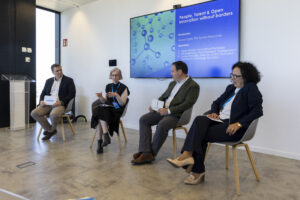
(L-R) TPS Human Resources, Moeve, Álvaro Casal; RMIT Vice-President Engagement, Michelle King; Innovation Processes, Moeve, Jesús Montes; Director of the Innovation Center, Moeve, Joana Frontela.
Drawing on RMIT’s international research and Moeve’s innovation ecosystem, the discussion examined how organisations can build connections across geographical and institutional boundaries and turn international collaboration into practical innovation.
The panel highlighted the growing importance of purpose for research talent. Researchers are increasingly seeking opportunities to contribute to pressing global challenges, rather than prioritising institutional prestige. Through its international fellowships, AuSpire connects researchers with industry partners, international expertise and environments where their work can contribute to practical impact on challenges such as climate adaptation, energy security and the transition to a low-carbon future.
Together, the panels demonstrated the ways in which AuSpire supports the energy transition: allowing innovative research to work towards industry application while building the international relationships and talent networks that are needed to address complex global challenges.
Building connections for a sustainable energy future
For AuSpire, the event represented an important step in demonstrating the value of international research partnerships and the opportunities they create for researchers, industry and the wider community.
As the program continues to connect Australian and Spanish research ecosystems, collaborations such as this provide a foundation for future innovation, talent development and research that supports the global energy transition.