
AuSpire Annual Event 2026
RMIT Europe and the Barcelona Supercomputing Center co-hosted the first annual in person event of AuSpire in April 2026.
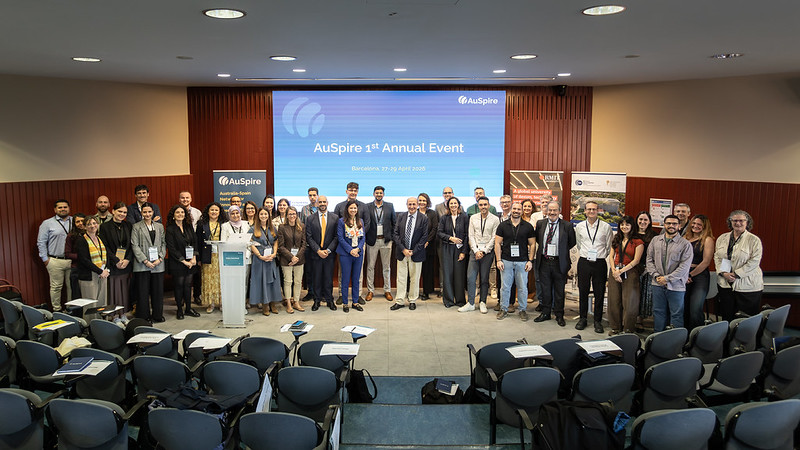
The first event of AuSpire has been held in Barcelona, assembling around 60 members of the AuSpire community, including recently recruited postdoctoral fellows and their supervisors, representing academic and industry partners in Australia and Spain.
The Spain-Australia Council Foundation Vice-Presidency was present on the first day as a sign of the Foundation’s support for the program, Australian institutions and research centres.
In his opening remarks, Australian Embassy in Madrid Deputy Head of Mission Peter Kakogiannis said that AuSpire represents a strong commitment to Australia-Spain research. “AuSpire will create long-lasting links and lay the groundwork for enduring collaboration between our two countries,” said Kakogiannis.
RMIT Europe Chief Executive Officer Marta Fernandez welcomed members of AuSpire’s growing international community and reflected on the program’s progress since its launch.
“We have appointed postdoctoral researchers from a range of research areas including decarbonisation, water and environmental systems, advanced materials, and AI-enabled health and infrastructure. This reflects an Australia–Spain collaboration already delivering on its promise to turn international partnership into real progress,” said Fernandez.
Barcelona Supercomputing Center Head of Machine Learning for Biomedical Research Unit of the Life Sciences Department Davide Cirillo highlighted AuSpire’s interdisciplinarity and ambition. “Bringing together a diverse group of researchers to work towards a shared vision of planetary wellbeing is no small feat,” said Cirillo.
To further explore this vision, RMIT’s Marta Fernandez moderated two panel discussions with AuSpire partners representing both academia and industry.
Luis Salvador Carulla, Professor of Mental Health and Deputy Director of the Health Research Institute at the University of Canberra, Susana Saiz, Regional Leader for Climate and Sustainability Services at Arup and Pedro Villanueva Rey, Head of Territorial and Social Sustainability at Cetaqua–Water Technology Centre shared their perspectives in the first panel, Planetary Health – From Insight to Impact.
They explored what planetary wellbeing means for their organisations and how it affects decision making, noting barriers such as regulatory lag and aversion to risk, and opportunities, highlighting examples of how planetary wellbeing is being embedded into current projects.
Daniel Casellas Padró, Scientific Director at Fundació Eurecat, Juan Carlos Latasa López, Technology Director, Head of Middle East Business Oil & Gas at IDOM, Iago González, Open Innovation Manager at Monodon by Navantia and Carlos Alberto Prieto Velasco, Manager of the Energy Transition Technologies Department at Moeve participated in the second panel, Planetary Health – A Shared Challenge, A Collective Response.
They reflected on why collaboration is essential for planetary wellbeing and energy transition initiatives, how to translate research from the lab to industrial-scale deployment, potential barriers to cooperation – from economic and technical to cultural and governance – and ways to align planetary wellbeing with business growth.
Chris Speed, Director of the Regenerative Futures Institute (RFI) and Professor of Design for Regenerative Futures at RMIT, was also in Barcelona to present to the AuSpire community. He underlined RMIT’s commitment to collaboration across disciplines, industry and communities, tackling big problems, and embedding Indigenous knowledge systems as central to regeneration.
The AuSpire annual event incorporated a range of networking opportunities, training sessions and site visits for the postdoctoral fellows, with a focus on aligning planetary wellbeing to their research projects.